‘Ali Bey had advanced in age, his strength had declined, and he was suffering from the gout. His patience had reached its limits with the Algerians who, availing themselves of the two weaknesses of his age and his illness, subjected him to increasing harassment. This is why the men of his government, on their own initiative, or at his secret instigation, asked him to designate his son Hammuda, who was a promising youth with a gift for leadership, as his heir-to-be. They cautioned him against conflicts that might otherwise arise at his death and rekindle the fire of civil strife. He lent his ear willingly to their proposal -- the love of one’s children is a trait of human nature -- and began implementing it with great wariness.
Thinking of all the possible consequences of one’s actions
And acting afterwards is the mark of a truly determined man.
His prudence was justified by the fact that his nephew Mahmud Bey, son of Muhammad Bey, was older than Hammuda, and he had promised, on his brother’s death, that he would protect the rights of Mahmud. ‘Ali Pasha’s rebellion against his uncle, and Yunis Bey’s rebellion against his father, were, in those days, events of the near past, and their vivid memory still fed tribesmen’s talks during their evening gatherings. ‘Ali Bey therefore kept silent about his intentions for the time being, and displayed the greatest solicitude towards his nephew -without, however, suggesting in any way that he wanted to bring him nearer to the exercise of power. He married him to his daughter, and children were born of that marriage.
‘Ali Bey started to entrust Hammuda with some of the tasks devolved to him as Bey, and, on days when he had to keep in bed and was unable to receive supplicants, for instance, would ask his son to go and talk to them. In the meanwhile, he kept a discreet watch on his nephew, who did not, however, show annoyance for being supplanted by his cousin. Mahmud seemed to acknowledge Hammuda’s superior intelligence and determination, as well as the impediment of his own physical inabilities, for he suffered, like his uncle, from the gout. He showed in this a pure heart and an equitable judgement. A day came when ‘Ali Bey finally revealed to his nephew the ministers’ request. He added that he had relinquished to the insistence of the “people of loosing and binding,” and stressed the urgency of the situation, facing the increased pressure exercised by the Algerians. Mahmud concurred with the ministers’ opinion and considered it judicious.
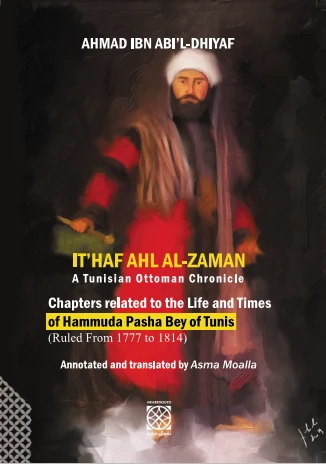
‘Ali Bey, from then on, devolved increasing powers to Hammuda for the administration of the province. Hammuda, after having orders written in his father’s name, would bring them to ‘Ali Bey, who put his signature and seal on those he approved, and rejected the others. Some time later, ‘Ali Bey sent an emissary to the Ottoman Sublime State (this was under the reign of the Sultan ‘Abd al-Hamid Khan), informing them that his people, seeing his old age and declining health, had agreed to have his son as Bey. The Ottoman State replied by sending an emissary from Istanbul, carrying a firman of investiture and other marks of power delegation from the Sultan to Hammuda.
The emissary went first to the Bardo palace, and then, accompanied by the Bey Hammuda, to the Divan in Tunis. A group of government officials and notables escorted them. They were greeted by the ‘asker and high officers of the Divan, lined according to their hierarchical order, starting from the agha to below. (Thus, Mahmud Bey was made to see clearly that all the “people of loosing and binding” wanted Hammuda as their Bey). Hammuda was clad in the Divan with the robe of honour brought by the emissary. The ceremony, attended by high commanders of the jund, the members of the Council of Religious Law and the notables of the capital, was a truly memorable event. Hammuda left the Divan, accompanied by the emissary and high officials, to the sound of cannon shots and music played by the Turkish band and went to Bardo, where ‘Ali Bey was waiting. Hammuda kissed his father’s hand and asked him to pray [for his success]. Ali Bey addressed a prayer to God, beseeching him to assist his son, then retired to his apartments, having unburdened himself from the load of government, happy with his deposition.
The Bey Hammuda Pasha then sat in the square of the Bardo fortress, on a seat that had been carved for ‘Ali Bey by a French joiner, from the teeth of a whale thrown by the sea on the beach of Sahleen [a locality of the Sahil], and on which he sat for ceremonies and on religious feasts. (This seat, until not long ago, was still used by the Beys, who saw in it a magnet of luck). Hammuda Pasha received the oath of allegiance (bay‘a) from the members of the Council of the Religious Law and other ‘ulama, army commanders and city notables.
Hammuda Pasha walked after that into the Pasha’s Hall, and the first of the dynasty’s members to swear allegiance to him was his cousin Mahmud Bey. Hammuda, to show that he held him in particular consideration, would not have him kiss his hand like the others. Then, after having received the oath of allegiance from the rest of the dynasty, he went to Mahmud’s house, as an additional expression of his esteem and affection for his cousin. (Hammuda, throughout the years of his government, never wavered from the habit of consulting Mahmud on important matters, and showed constant trust and affection towards his cousin and brother-in-law. As for Mahmud Bey, he lived during that period a discreet withdrawn life, with a limited retinue and few followers, content with the fate traced to him by God, rested in mind and body. But God, as the author of Al-Khulasa al-naqiyya points out, was to reward him later for this virtuous behavior, since he, and after him, his children and his children’s children, inherited supreme rule over the country).
The oath of allegiance was given to Hammuda on the 1st of Muharram 1191 (Sunday 9 February 1777). He assumed the command of the next winter and summer mahallas [fiscal expeditions], taking with him a great number of government officials, which made his father complain, “How can you all go and leave me by myself?” ‘Ali Bey acted as Hammuda’s deputy when the latter was out with the mahallas, and Hammuda, out of deference for his father, continued to write orders in his name and close them with his seal.
A day came when ‘Ali Bey felt that his health had dangerously deteriorated. Mustafa Khuja, his trusted minister and son-in-law, was then out of the country, on a pilgrimage to the Holy Places. He forbade his son from taking the command of the next mahalla and the latter gave his agreement, on condition that his deputy for that expedition should be chosen by himself, for he feared that his father might designate Isma‘il Kahiya. ‘Ali Pasha agreed to this condition and said to his son, “I have forbidden you from taking the command of the mahalla, fearing that death should take me away in your absence.” God fulfilled ‘Ali Bey’s wishes and his ever dutiful and affectionate son was present at his bedside as he gave up his last breath.
‘Ali Bey departed from this world, content, respected, thankful for God’s blessings, on 18 Jumada II, 1196 (Friday 31 May 1782), and was buried in his turba. He was born in Shawwal 1124 and governed the country for twenty four years. May God have mercy upon him.